Read the visual description
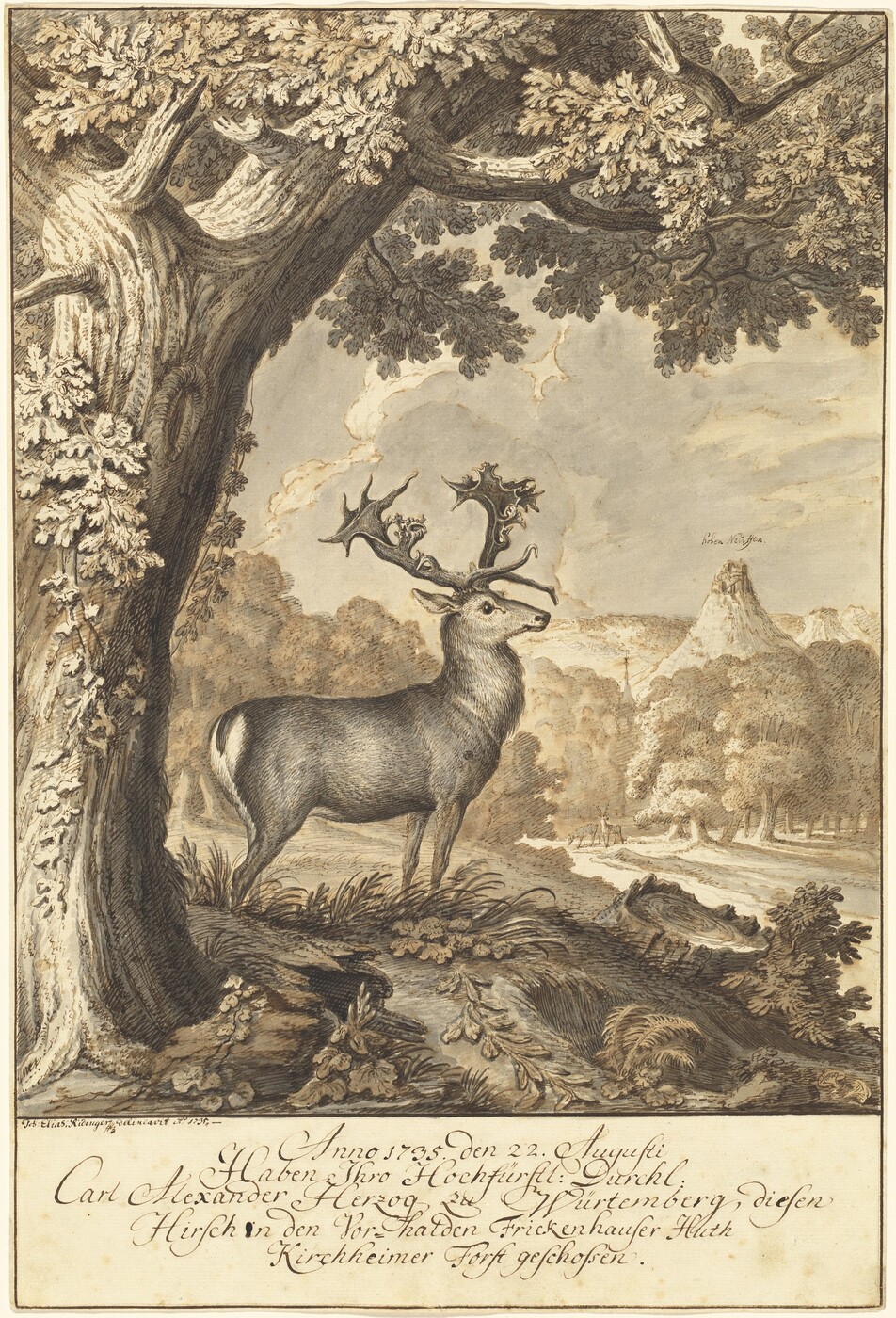
The illustration features a stag standing on a patch of grass and foliage. The perspective is such that the viewer looks slightly upwards at the stag. Above the stag is the horizon, showing a rocky outcrop or hill against the sky in the distance. The image has a detailed, monochromatic palette with shades of brown, beige, and gray. The fur of the stag, tree trunk, and leaves show cross-hatching and delicate lines for texture and depth. The sky is gray with a few clouds, enhancing the earthy tones of the landscape. The detailed illustration aims to capture the natural elegance of the forest scene realistically.
National Gallery of Art · Drawing
A Stag beneath a Mighty Oak
Johann Elias Ridinger
- Date
- 1735
- Medium
- pen and brown and gray ink with brown and gray wash over graphite on laid paper
- Dimensions
- sheet: 45.8 x 30.9 cm (18 1/16 x 12 3/16 in.)
- Classification
- Drawing
- Accession number
- 2007.111.151
- Credit line
- Wolfgang Ratjen Collection, Patrons' Permanent Fund
- Time span
- 1726 to 1750
- Department
- CG-E
Subjects and terms
- German
- Landscape
- Tree
- Trees
- Deer
- Writing
Provenance
Johan August Gottleib Weigel (1773-1846), Leipzig; Theodor Oswald Weigel (1812-1881); (J.A.G. Weigel sale, Gutekunst, Stuttgart, 15 May 1883, no. 1243). (Karl & Faber, Munich). (August Laube Antiquariat, Zurich). (David Tunick, Inc., New York) 1985. (Galerie Arnoldi-Livie, Munich) 1987. Wolfgang Ratjen, Munich; purchased 2007 by NGA.
Inscription
signed and dated at bottom left in brown ink: Joh: Elias. Ridinger delineavit A:o 1735.; inscribed by the artist at bottom center in brown ink: Anno 1735 den 22. Augusti/Haben Ihro Hochfürstl. Durchl:/Carl Alexander Herzog zu Würtemberg, diesen/Hirsch in den Vor--halden Frickenhauser Huth/Kirchheimer Forst geschossen.; inscribed by the artist at center right aove the castle in brown ink: hohen Neuffen
Watermarks
fleur-de-lys on shield, topped with horned crown, with subscript letters WR
NGA object ID 139252. Collection metadata is reproduced under CC0. This work is included because its NGA published-image record is marked open access; visitors should recheck the source record before substantial reuse.