Read the visual description
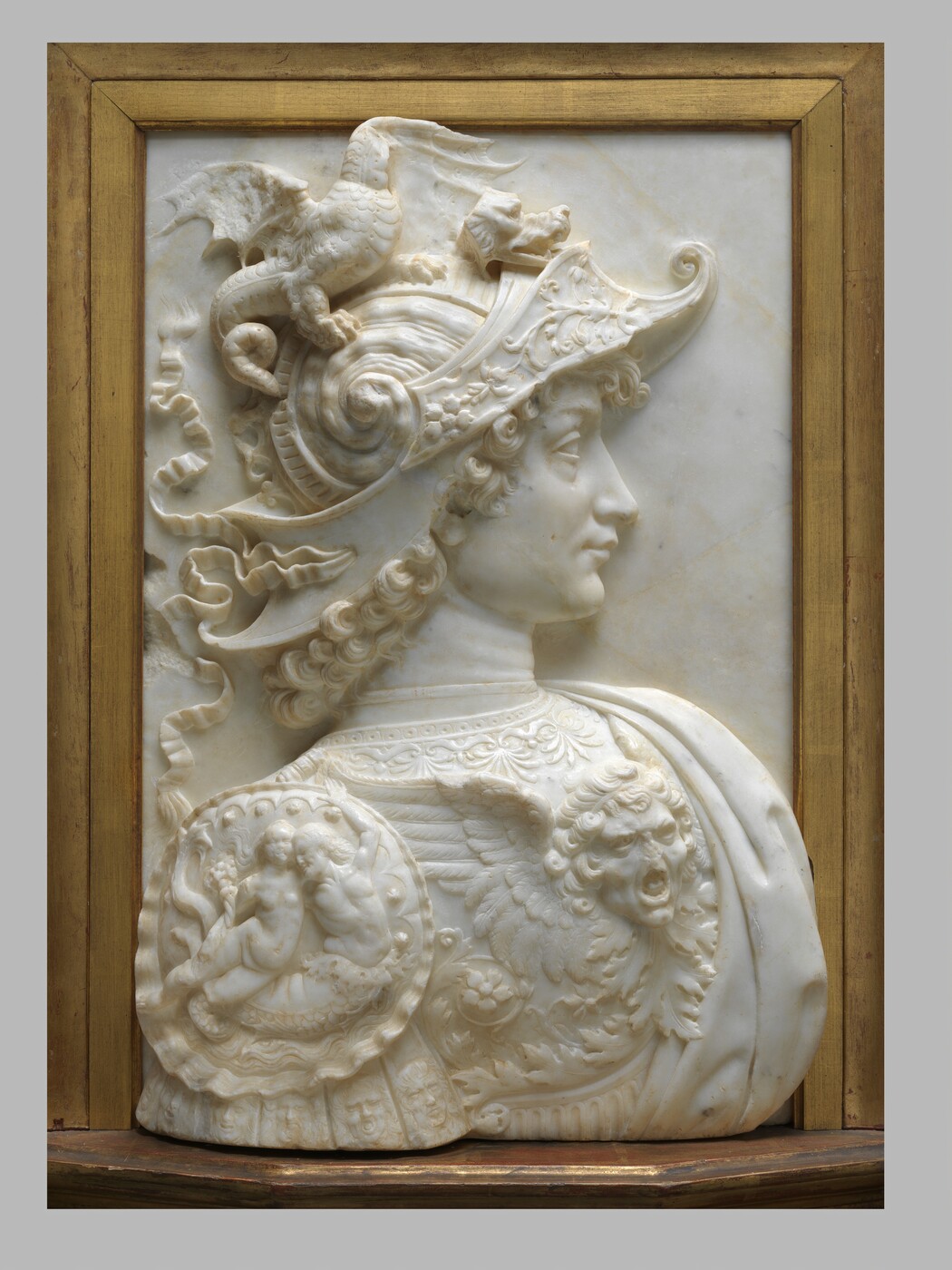
Set within a gold frame, the head and chest of a young man wearing an ornate helmet and armor, facing our right in profile, is carved in relief from white marble in this vertical panel. The man has a long nose, smooth cheeks, closed bow lips, and a snub chin. Curls burst from beneath his helmet, which sweeps from up over his forehead down to the back of his neck. The lifted visor curves up and out past his nose, and is decorated with vines and flowers. The crown of the helmet spirals like a snail shell over the man’s head, and a dragon perches along the top. The dragon has a dog’s head, a scaled body, wings like a bat, a serpent-like tail, and a section of its long neck has been broken off. Two crimped ribbons flutter up and behind the man’s head from the back of the helmet, where it covers his neck. His chest is covered to his neck with a highly ornamented breast plate. At the front of the chest, an adult face with brows furrowed and mouth wide open is flanked by wings. The shoulder we can see is covered with a medallion showing a nude woman holding a cornucopia and a merman. Beneath the medallion, a row of six faces, each on its own narrow panel, fan out over the man’s upper arm. Scrolling vines, leaves, and flowers fill the remaining space around the medallion and winged head. A few pale, parchment-white veins run through the surface of the marble. The panel sits on a shallow, trapezoidal ledge and is framed in a stepped gold frame on the remaining three sides.
National Gallery of Art · Sculpture
Alexander the Great
Workshop of Andrea del Verrocchio
- Date
- c. 1483/1485
- Medium
- marble
- Dimensions
- overall: 55.9 x 36.7 cm (22 x 14 7/16 in.) framed: 88.9 x 71.8 x 8.6 cm (35 x 28 1/4 x 3 3/8 in.)
- Classification
- Sculpture · Relief
- Accession number
- 1956.2.1
- Credit line
- Gift of Therese K. Straus
- Time span
- 1401 to 1500
- Department
- CSD
Subjects and terms
- Florentine
- European Sculpture 1300-1800
- Renaissance
- Alexander the Great
- history
- portrait
Provenance
Possibly Hungarian private collection.[1] Unknown collection, Vienna, in 1922.[2] (E. & A. Silberman, Vienna).[3] (Jacques Seligmann et Cie., Paris and New York) by January 1927;[4] sold 28 December 1927 to Therese K. [Mrs. Herbert N.] Straus, New York; gift 1956 to NGA. [1] No direct documentation has been found. The Hungarian collection is first mentioned by Leo Planiscig, “Andrea del Verrocchios Alexander Relief,” _Jahrbuch der Kunsthistorischen Sammlungen in Wien_, n.s. VII (1933): 89-96. Hanns Swarzenski, in a report inscribed 1/31/1945, refers to the “lack of history before 1923. Mysterious provenance in Hungary. Sponsorship in the first instance by a Hungarian dealer..." A slightly later report by Charles Seymour quotes Swarzenski as commenting that “ the dealer Silberman, an Hungarian himself, told me that he discovered the piece walled in in an Hungarian castle.” (copies, NGA curatorial files). [2] In a letter dated 13 September 1927, Wilhelm von Bode wrote to the dealer Seligmann that in 1922 the relief was in Vienna; in that year Bode had received, through Prof. Suida in Vienna, a photograph of it with the upper corners broken off. (Jacques Seligmann et. Cie Papers, Archives of American Art, Box no. 210/folder 5, copies NGA curatorial files). The Viennese location may refer to possession by the dealers E. & A. Silberman. See note 1. [3] After the relief was purchased by Mrs. Straus, she was contacted by A. Silberman, who referred to the relief as having been in his firm’s possession (letter dated 15 January 1938, Jacques Seligmann et. Cie Papers, Archives of American Art, Box no. 210/folder 5, copies NGA curatorial files). See note 1. [4] Correspondence concerning the relief between Seligmann and Soloman Reinach from January 1927 (Jacques Seligmann et. Cie Papers, Archives of American Art, Box no. 210/folder 5, copies NGA curatorial files).
NGA object ID 43513. Collection metadata is reproduced under CC0. This work is included because its NGA published-image record is marked open access; visitors should recheck the source record before substantial reuse.