Read the visual description
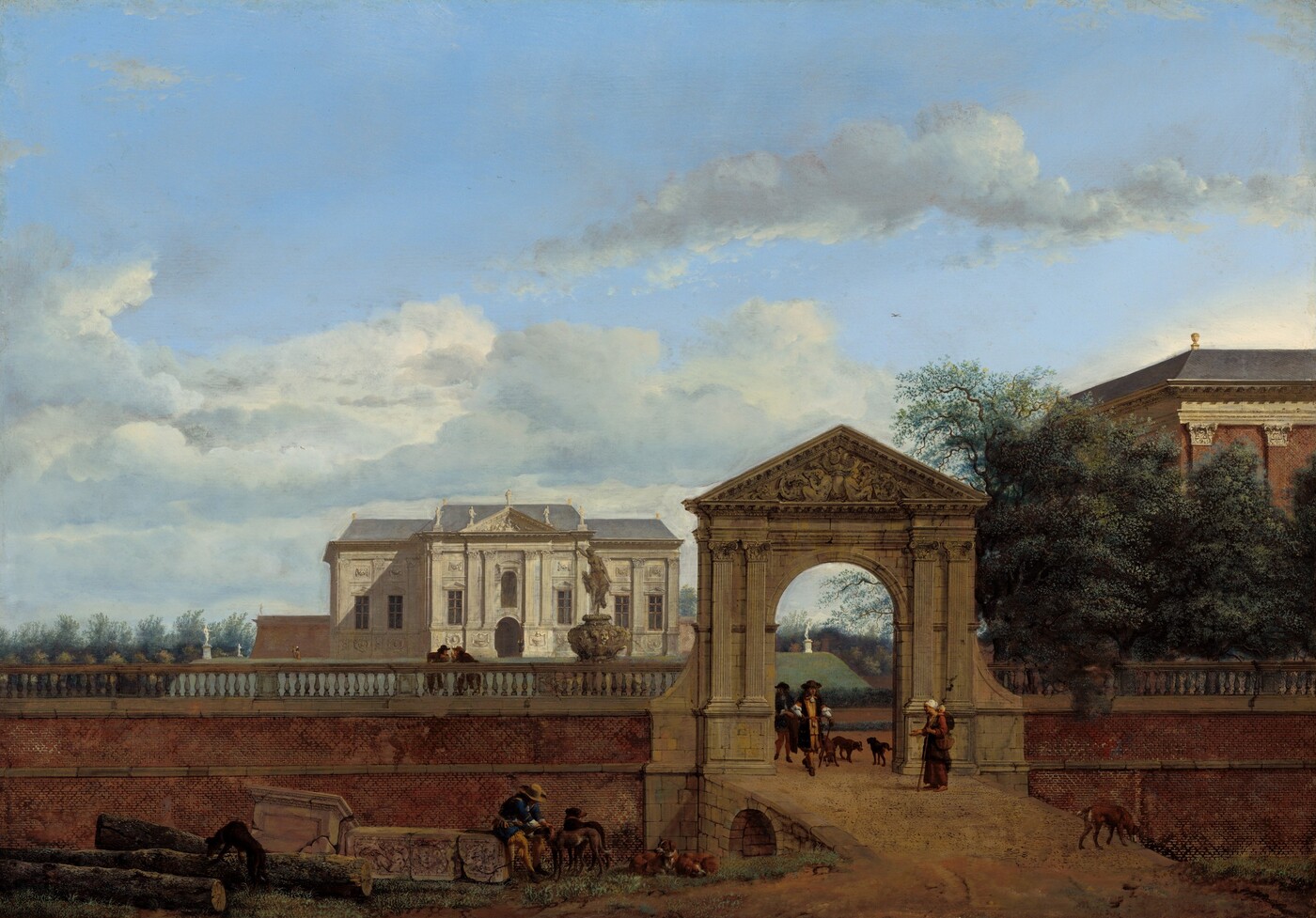
We look across a dirt road or path at a tall, brick wall flanking an ornamented, stone gateway with a white, marble manor house in the distance in this horizontal landscape painting. Atop a low hill, the sunlit manor is outlined against a vivid, light blue sky with silvery-gray, fluffy clouds, which fills the top two-thirds of the composition. Statues line the gray, tiled roofline along the central section of the house, and more statues stand in the grassy lawn to either side. Closer to us, the gateway and people around it are cast into shadow. The arched gate is flanked by flat columns and is topped with a triangular pediment filled with relief sculpture of people and ornamental scrolls. A ramp leads up to the opening of the gate. Two men passing under the arch have long, brown hair and wear brimmed hats, long coats, breeches tied at the knee, and stockings. The man in front carries a walking stick. A woman wearing a white head covering and long, dark dress, carries a baby tied to her back and holds her hand out toward the men. Near the men, three brown dogs walk as one raises a leg against the gate, and a fourth sniffs at the side of the ramp where it meets the ground. The red brick wall is topped with a balustrade. To our left of the gate and on the far side of the wall, two men lean on the balustrade, angled in toward each other as if in conversation, near a fountain with a sculpted woman on an ornamental urn. Below them, at the foot of the brick wall, a man sits on a cracked piece of marble sculpted with ornamental designs in low relief. The man wears a royal-blue suit with golden yellow stockings and a tan, brimmed hat. He leans forward to touch the collar of a long-legged, slender dog while four other dogs stand, sit, and lie down nearby. To our right, the roofline of a large, red brick building is seen over the tops of a grove of trees on the far side of the wall. The painting style throughout is detailed and precise, so one could conceivably count the individual bricks in the wall, for instance.
National Gallery of Art · Painting
An Architectural Fantasy
Jan van der Heyden
- Date
- c. 1670
- Medium
- oil on oak panel
- Dimensions
- overall: 49.7 x 70.7 cm (19 9/16 x 27 13/16 in.) framed: 69.2 x 90.1 x 6.3 cm (27 1/4 x 35 1/2 x 2 1/2 in.)
- Classification
- Painting
- Accession number
- 1968.13.1
- Credit line
- Ailsa Mellon Bruce Fund
- Time span
- 1651 to 1700
- Department
- CNE-B
Subjects and terms
- painted surface
- Baroque
- Dutch
- exterior
- architecture
- Dutch Paintings of the Seventeenth Century (NGA Online Editions)
- Country home
- landscape
Provenance
Woltgraft family, Kampen.[1] Catellan family, Freiburg im Breisgau, before 1816; (sale, by Laneuville and Chariot, Paris, 16 January 1816, no. 6);[2] Maurice Rubichon for Charles-Ferdinand de Bourbon, duc de Berry [1778-1820], Paris;[3] by inheritance to his wife, Marie-Caroline-Ferdinande-Louise de Naples, duchesse de Berry [1798-1870], Paris; (De Berry exhibition and sale, Christie & Manson, London, April-June 1834, no. 112, apparently bought in);[4] (De Berry sale, by Bataillard and Charles Pillet, Paris, 4-6 April 1837, no. 72); Hazard.[5] Charles Heusch [c. 1775-1848], London, probably by 1838;[6] by inheritance to his son, Frederick Heusch [1809-1870], London; acquired 1855 with the entire Heusch collection by Baron Lionel Nathan de Rothschild [1808-1879], London;[7] by inheritance to his son, Alfred Charles de Rothschild [1842-1918], London and Halton House, near Wendover, Buckinghamshire; by inheritance to his nephew, Lionel Nathan de Rothschild [1882-1942], Exbury, Hampshire; by inheritance to his son, Edmund Leopold de Rothschild [1916-2009], Exbury; sold 1968 to (Thos. Agnew and Sons, Ltd., London); purchased 12 June 1968 by NGA. [1] The coat of arms on one of the two wax seals affixed to the back of the panel displays a stork with an eel in his beak and three stars in the chief. This has been identified by C.W. Delforterie (subdirector, Centraal Bureau voor Genealogie, The Hague) as that of the Woltgraft family of Kampen, Overijssel (letter, 25 May 1981, in NGA curatorial files). [2] John Smith, _A Catalogue Raisonné of the Works of the Most Eminent Dutch, Flemish and French Painters_, 9 vols., London, 1829-1842: 5:396, records that the seller in 1816 was "Madame Catalan," a claim that is reinforced by the design of the second wax seal on the back of the panel, which shows a golden castle in a field of gules, surmounted by a crown. Walter Angst, senior conservator, Smithsonian Institution, has confirmed in conversation (10 June 1981 and 15 January 1982) that this coat of arms is consistent with that of the noble family of Catellan, of Freiburg im Breisgau, and so it seems reasonable to assume that the painting was in their possession sometime before 1816. (For reproduction of the Catellan arms see Johannes Baptist Rietstap, _Armorial général illustré_, 3rd ed. by Victor and Henri Rolland, Lyon, 1953: 2:pl. 40.) In addition, the title page of one of the copies of the sale catalogue in The British Library, London, is inscribed "de Catalan." On the other hand, Frits Lugt, _Répertoire des catalogues de ventes_, 4 vols., The Hague, 1938-1964: 1:no. 8797, gave the seller's name as "Le Rouge," which is also written on the copy of the sale catalogue in the Rijksbureau voor Kunsthistorische Documentatie (RKD), The Hague. Several other copies of the sale catalogue are inscribed with variations of the same name; see the description of Sale Catalog F-610 in The Getty Provenance Index Databases. This is possibly the dealer Nicolas Le Rouge; see Patrick Michel, _Le Commerce du tableau à Paris dans la seconde moitié du XVIIIe siècle_, Villeneuve-d'Ascq, 2007: 55-56. No evidence yet exists to substantiate Le Rouge's ownership of _An Architectural Fantasy_. [3] Ink notation in copy of the 1816 sale catalogue at the RKD, The Hague; the picture is described as "La vue d'un superbe château..." [4] The catalogue describes the collection as "...Dutch and Flemish pictures of his late royal highness the Duke de Berri [_sic_]: which formed the celebrated cabinet of l'Elysée Bourbon: and now exhibiting for sale by private contract..." Helga Wagner, _Jan van der Heyden, 1637–1712_, Amsterdam and Haarlem, 1971: no. 151, 101, lists this exhibition and sale as simply an exhibition at the British Institution, London. The 1834 British Institution exhibition, however, did not in fact contain any paintings by Van der Heyden. Marijke C. de Kinkelder from the RKD, The Hague, explained the confusion by providing information about the 1834 exhibition and sale (see her letter of 16 December 1987, in NGA curatorial files) . [5] Ink notation in the NGA library copy of the sale catalogue, in which the subject of the painting is described as "La maison de plaisance." The collection being sold was described as the "Ancienne Galerie du Palais de l'Élysée." [6] Smith 1829-1842, 9(1842):675, no. 21, describes the painting as a "View of a handsome Chateau" and calls this entry an "improved" version of his earlier text, 5(1834):396, no. 87. In the expanded version, Smith mentions the telling detail of a man seated on an architectural fragment, "putting a collar on a dog," which allows the picture he describes to be conclusively identified as _An Architectural Fantasy_. In 1834 he lists the painting as in the collection of the Duchesse de Berry, and by 1842 it is owned by Heusch. It should be noted, however, that by 1842 there was already confusion about the identity of the painting, which appears in the literature under a variety of titles--confusion that must be at least partly due to Van der Heyden's habit of reusing the same genre elements in different works and of painting several versions of the same scene. Smith suggests that his 9(1842): no. 21 is "probably" the same as his 5(1834): no. 21. The latter, titled by Smith _A View of the Château of Rosindal_, corresponds closely to _An Architectural Fantasy_ in its dimensions and genre elements, in so far as they are described, but it has a different provenance that Smith traces through sale catalogues. According to the earliest of these (Blondel de Gagny, Paris, 10 December 1776, 59, no. 154), _La vue du Château de Rosindal_ was painted on copper. _An Architectural Fantasy_, on the other hand, is painted on wood, and the building in it bears no resemblance to the Château of Rosindal as it was depicted in numerous drawings and engravings. Compounding the confusion, Charles Heusch exhibited a painting entitled _Château de Rosindal_ at the British Institution, London, in 1838 (no. 91; see Algernon Graves, _A Century of Loan Exhibitions, 1813-1912_, 5 vols., London, 1913-1915: 4[1914]:1471). While the painting in Heusch's collection may have been the above-mentioned painting on copper, it may equally have been _An Architectural Fantasy_ mistitled based on Smith's 1834 entry. Later, Cornelis Hofstede de Groot, _A Catalogue Raisonné of the Works of the Most Eminent Dutch Painters of the Seventeenth Century..._, 8 vols., trans. from the German edition, London, 1907-1927: 8:426, no. 227, proposed that a third entry in Smith 1829-1842, 5(1834):385, no. 49, was a variant description of Smith nos. 21 and 87, undoubtedly because similar genre details, including the gentleman giving alms to a beggar, were described in all three entries. However, Hofstede de Groot's proposal can be rejected, firstly because Smith no. 49 was a vertical painting measuring 18 x 16 inches, and secondly because examination of the sale catalogues Smith lists under his nos. 49 and 21 clearly demonstrate that these were two separate paintings, and both were different from Smith no. 87, the NGA painting. Smith nos. 49 and 21 are now apparently lost and are not included in the catalogue raisonné by Helga Wagner, _Jan van der Heyden, 1637-1712_, Amsterdam and Haarlem, 1971. [7] The description in Charles Davis, _A Description of the Works of Art Forming the Collection of Alfred de Rothschild_, London, 1884, no. 34, is a verbatim copy of Smith 1829-1842, 9(1842):675, no. 21. The Rothschild provenance information through the 1968 sale to Agnew was kindly provided by Michael Hall, curator to Edmund de Rothschild; see his "Rothschild Picture Provenances" from 1999 and letter of 27 February 2002, in NGA curatorial files, in which he cites relevant documents in The Rothschild Archive, London.
NGA object ID 50883. Collection metadata is reproduced under CC0. This work is included because its NGA published-image record is marked open access; visitors should recheck the source record before substantial reuse.